

Trumpeter Swans, West Shoal Lake, photo by Rudolf Koes
How do I recognize it?
Of the two regularly occurring species of swan in Manitoba – Tundra Swan and Trumpeter Swan – the latter is the bigger bird, but this is often difficult to discern in the field. The Trumpeter Swan has a longer bill, the base of which surrounds the eye. Feathering of the forehead comes to a point above the upper mandible, rather than the rounded border of a Tundra Swan. Trumpeter Swans rarely show any yellow at the base of the upper mandible, but often have a red gape. All these differences are subtle and often of no help, unless the bird is seen at close range. Trumpeter Swan is best recognized by its call note, which is diagnostic.
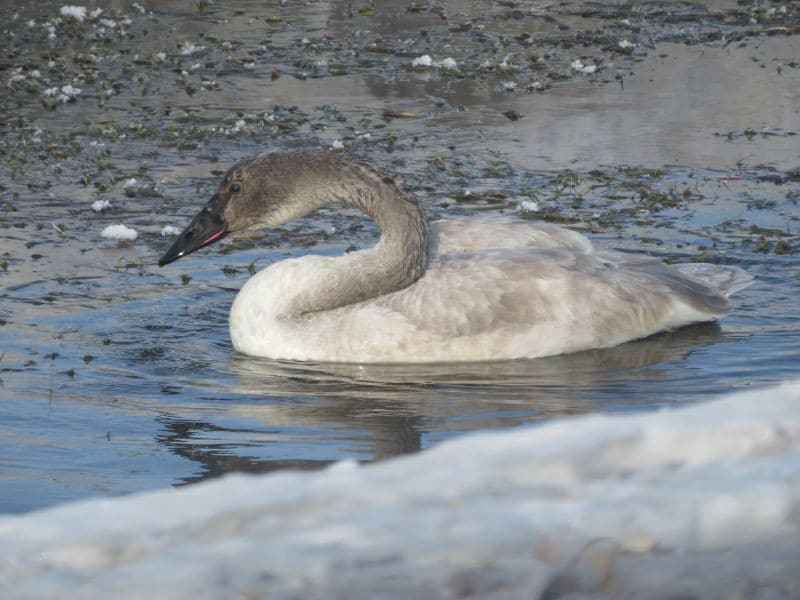
Trumpeter Swan, Oak Hammock Marsh in March 2023 photo by Lori Gomes
Does it migrate?
Lack of open water to feed in forces almost all waterfowl, swans included, to leave Manitoba in fall. Most interior breeders, including “ours”, winter in central USA. Given the recent rapid expansion of the breeding range, the winter range will undoubtedly also expand. In spring the first birds arrive as early as the first days of March, while in fall most depart at freeze-up. One juvenile bird spent the winter of 2022-2023 at a drain north of Oak Hammock Marsh, the first swan of any kind known to have survived a Manitoba winter.
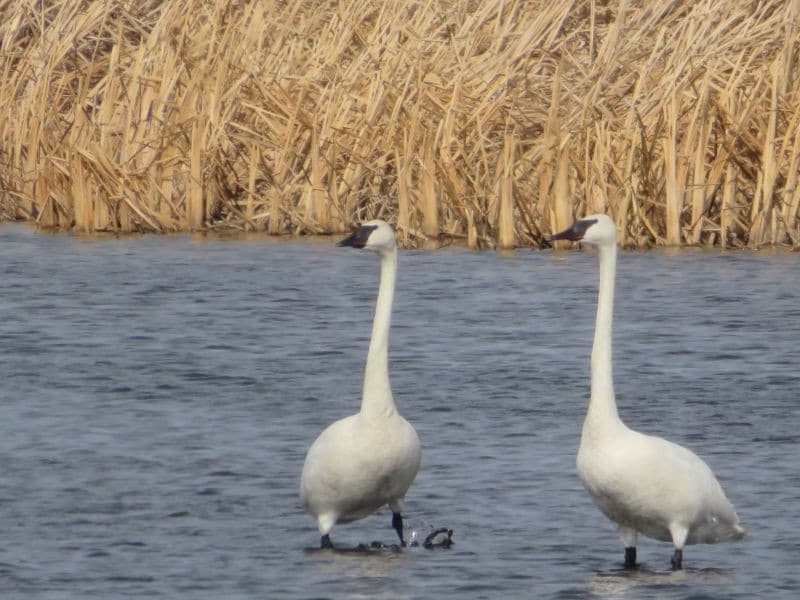
A pair of Trumpeter Swans, Kaleida Marshes, Manitoba photo by Rudolf Koes
Where does it live?
Nesting in Manitoba takes place at forest ponds and large prairie marshes in the central and southern parts of the province.
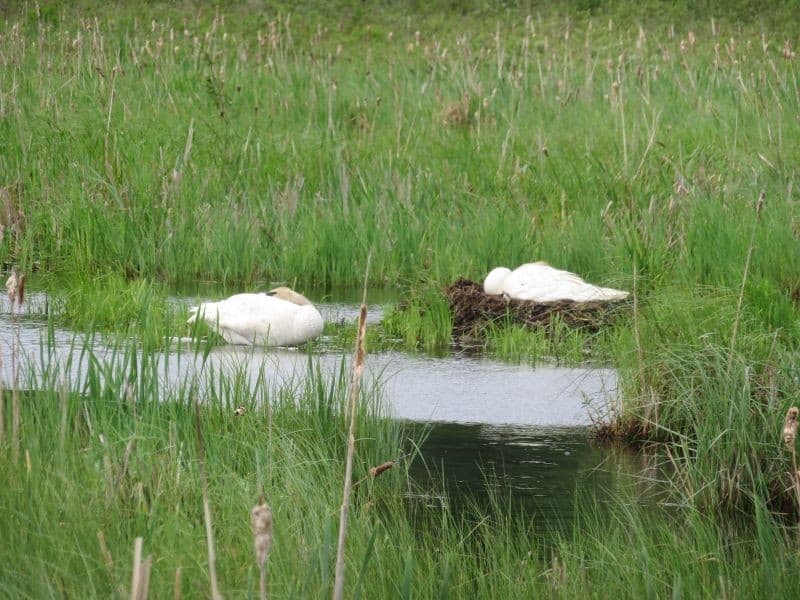
Trumpeters Swans nesting in NW Ontario photo by Rudolf Koes
Where can I see it?
Any swan seen in southern or central Manitoba in summer is bound to be a Trumpeter. Reliable locations in recent years have been the Whiteshell area and Nopiming P.P., the marsh at the east end of the Hecla Island causeway, Oak Hammock Marsh and Riding Mountain N.P.
Conservation Status.
Trumpeter Swans were extirpated as breeders in our province by the late 1800s, which was due to intensive hunting and trapping for skins, down and quills. It was believed that the species was extinct, until a healthy population was found in Alaska. Release programs in Ontario and Minnesota in the second half of the 20th century were successful, with offspring venturing north and west into Manitoba and re-occupying much of the former breeding range.
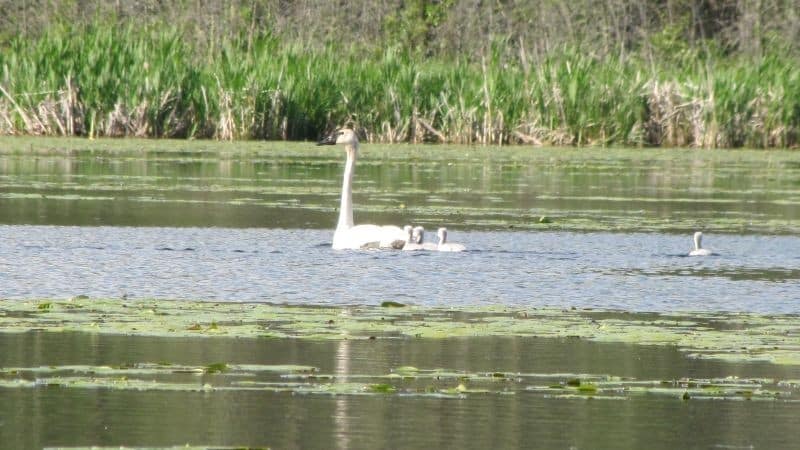
Trumpeter Swan swimming with offspring photo by Rudolf Koes
Did you know?
Trumpeter Swans are the largest and heaviest birds native to North America. They can weigh up to 12 kg and the wingspan can be anywhere from 2 to 3 m. Immature birds have dusky necks well into their second year, unlike Tundra Swans, which have white necks early in the year following hatching.
Written by Rudolf Koes