

Canada Geese at Assiniboine Park, photo by Rudolf Koes
What does it look like?
Canada Geese come in various sizes, from some birds barely larger than a Mallard and others over a metre long and weighing up to 4.5 kg. All can be recognized by their black necks and white chinstraps, with the remainder of the plumage largely brown with a white abdomen. Bill, feet and tail are black. A smaller look-alike, Cackling Goose, was found to be not closely related and split in 2004.
Does it migrate?
Although on occasion a few can overwinter, most birds head south for the winter. Interestingly, most birds that breed in southern Manitoba only travel as far south as southern Minnesota and areas nearby, while more northerly breeders leapfrog the southern birds and may travel as far as the southern states and Mexico. In spring the first geese may arrive as early as late February or early March.
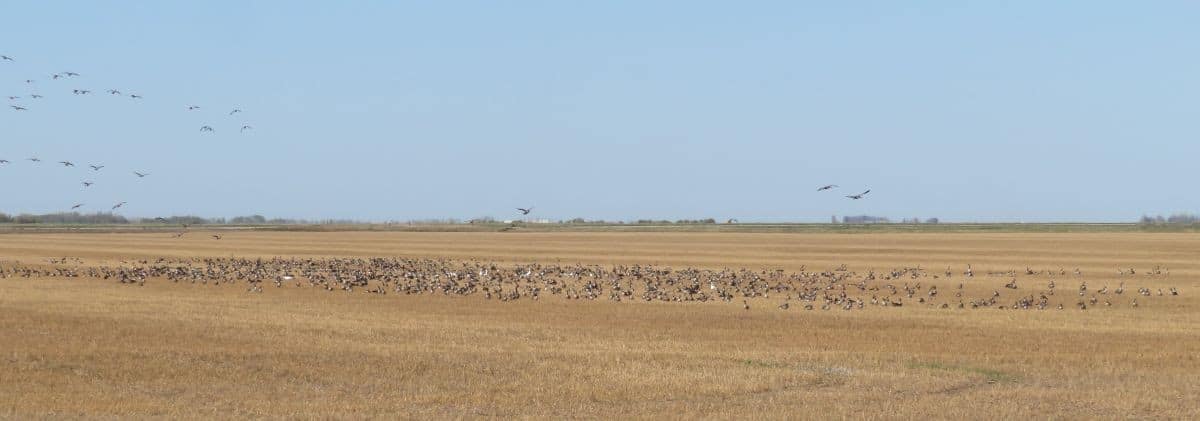
Canada Geese gathered at Oak Hammock Marsh, photo by Rudolf Koes
Where does it live?
This species breeds across most of Canada and the northern half of the United States. It has been introduced in many other parts of the world and is thriving everywhere, much to the chagrin of farmers, golfers and many others. It is a common bird throughout the province, with substantial numbers breeding in Winnipeg and other cities and towns, some even nesting on flat roofs and other man-made structures.
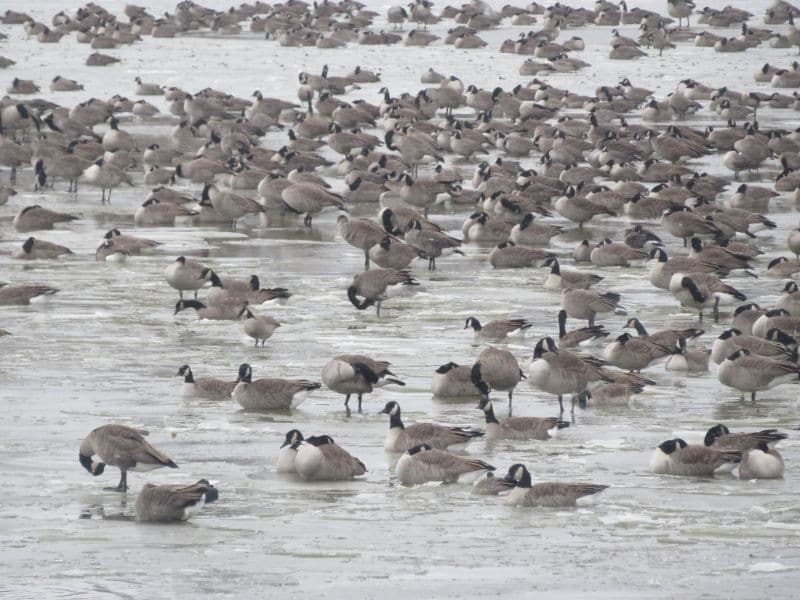
Canada Geese in Portage La Prairie, photo by Rudolf Koes
Where can I see it?
As mentioned above, this species is so widespread that it hard to miss for much of the year.
Conservation.
There are no conservation concerns for this species. Although hunters take birds both in spring and fall, this has failed to slow the growth of the population.
Did you know?
In the mid 20th Century the subspecies of Canada Goose native to southern Manitoba, the so-called Giant Canada Goose, was considered endangered. In order to bolster the numbers, goose sanctuaries and breeding programs were established near Rennie (Alf Hole Goose Sanctuary) and at East Meadows Ranch (Marshy Point), southwest of Lundar. As we all know now, these efforts were only too successful!
Written by Rudolf Koes