

Above: Bank Swallow by Garry Budyk
What Does It Look Like?
The Bank Swallow (Riparia riparia) looks similar to another species, the Northern Rough-winged Swallow. Both species have a brown back with white belly, dark, triangular underwings, and a slight forked tail. In contrast, the Bank Swallow has a dark breast band and white feathering around its neck.
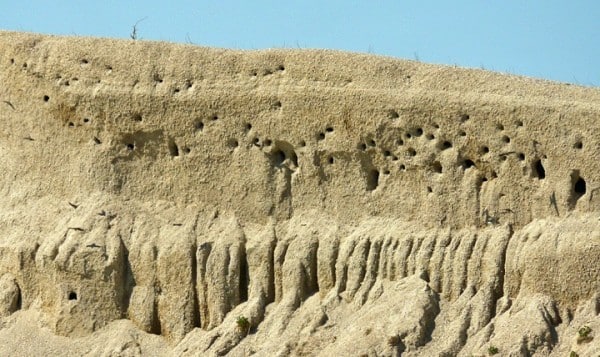
Above: Bank Swallow colony by Peter Taylor
Where Does It Live?
This is a fairly widespread species, known in Europe as Sand Martin. Both names are apt. They breed in large colonies, excavating cavities in gravel and sand banks, most notably along rivers, but also in sand and gravel piles in construction sites and rail yards. The global breeding range covers much of Europe, Asia, North Africa and North America. In Canada they are a widespread breeding species except for coastal and northern British Columbia, the Arctic and parts of Newfoundland and northwestern Alberta. During the compiling of the Manitoba Breeding Bird Atlas, the highest concentrations of this species were in the prairie potholes and in the northeast.
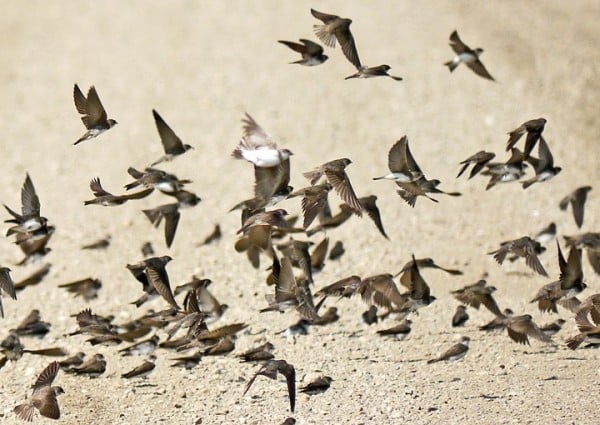
Above: Bank Swallows by Peter Taylor
Does It Migrate?
This is a species which feeds on flying insects which are scarce at minus twenty! Yes, it migrates from the northern Pacific coast of Mexico down to South America.
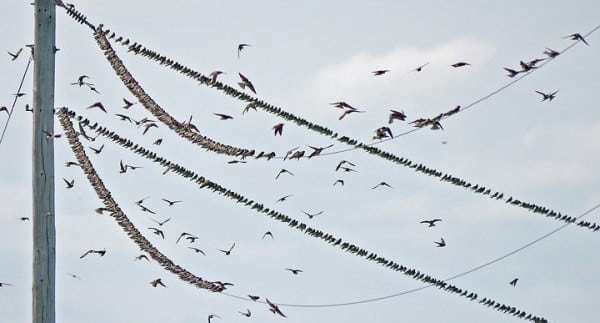
Above: Bank Swallows on power lines by Peter Taylor
Where Can I See It?
Look out for this species where there are steep river banks with exposed sand caused by recent erosion. Some of the larger colonies in Manitoba are found along the largest rivers including the Souris, Assiniboine, and Pembina. Relative abundance was also high along the mighty northern rivers, notably the Hayes, Owl and Lower Nelson. In late July and early August, thousands of Bank Swallows can be seen on roads and on power lines at Whitewater Lake near Deloraine.
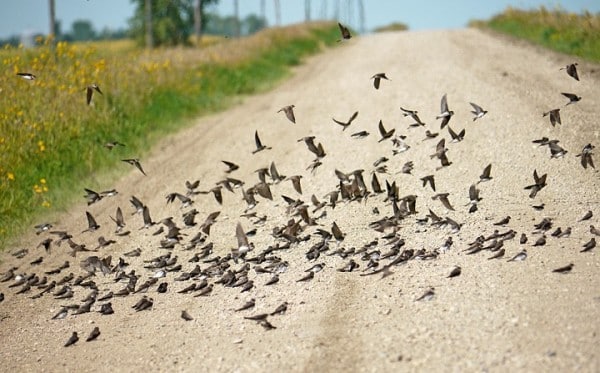
Above: Bank Swallows at Whitewater Lake by Peter Taylor
Conservation:
This species is designated as threatened under the federal Species At Risk Act. It belongs to the guild of aerial insectivores, a group of birds which has declined in Canada at a precipitous rate since the 1970's. One possible issue for this species is the destruction of nests in active gravel pits.
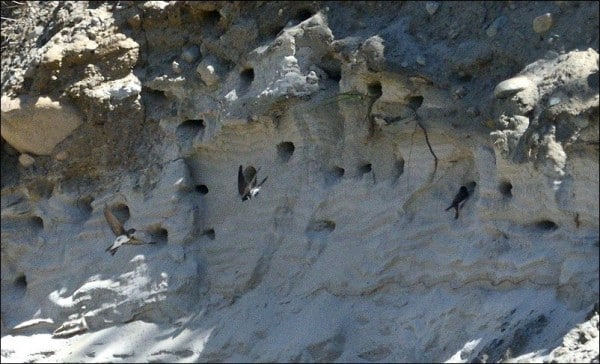
Above: Bank Swallow nest cavities by Gary Budyk
Did You Know?
Bank Swallows excavate their own nest cavities using their feet, wings and beaks.