

Above: Adult female (left) and male Common Goldeneyes at Lee River, 11 April 2015; by Peter Taylor.
How do I recognize it?
An adult male Common Goldeneye is one of the whitest ducks. Its head appears black at a distance, but shows green or purple iridescence at close range in bright light. A white patch of feathers between the eye and bill is the shape of a gibbous moon, and the eyes are indeed a golden yellow, a colour they share with several other diving ducks. Adult females and juveniles have a brown head and grey body, with large white patches on the wings that are often folded out of sight. In breeding condition, adult females have a yellow tip to the bill. Immature goldeneyes have dusky eye colour, while adult females’ eyes are straw-yellow rather than golden.

Above: Males often outnumber females in courting parties of ducks in spring, such as this group of Common Goldeneyes at Pine Falls, 18 April 2014; by Peter Taylor.
Does it migrate?
Common Goldeneyes breed in boreal regions of Eurasia as well as North America, and overwinter in more temperate regions farther south and along coasts. A very small number spend the winter in Manitoba at patches of fast-flowing open water, notably at dams and rapids along the Winnipeg River.
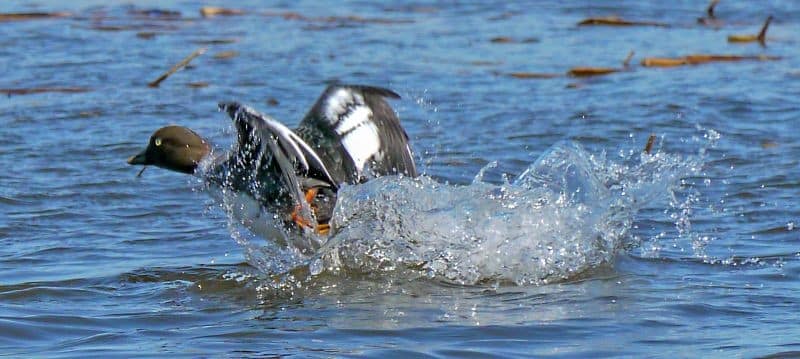
Above: The splashy initial thrust of a female Common Goldeneye taking off near Pinawa, 22 April 2015; by Peter Taylor.
Where does it live?
Common Goldeneyes are widespread on Manitoba’s boreal lakes and rivers, nesting in old woodpecker cavities near the shore. They will use nest boxes set out primarily for Wood Ducks, and a few now breed at Winnipeg, Portage la Prairie, and other locations south of the boreal forest. Flocks of moulting goldeneyes, mostly males (which, like most male ducks, don’t attend their young) gather along the Hudson Bay coast in summer.
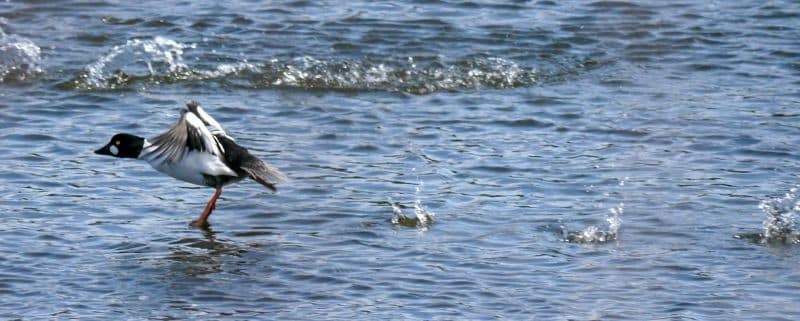
Above: A series of splashes made by the pattering takeoff run of a male Common Goldeneye at Pinawa, 3 April 2015; by Peter Taylor.
Where can I see it?
Common Goldeneyes are among the earliest spring migrants, with the first arrivals in late March, about when the first Canada Geese come back. From then through April and much of May, goldeneyes are a common sight along major rivers and at openings in lake ice. They will also drop in briefly at large sloughs and sheets of meltwater in agricultural land. The first broods of white-faced young appear around the end of May, and are close to fully grown by late July. In autumn, small flocks can usually be seen at Victoria Beach and elsewhere on Lakes Winnipeg and Manitoba. Listen for the high-pitched sound of their wings, which earned them the nickname “whistlers”.
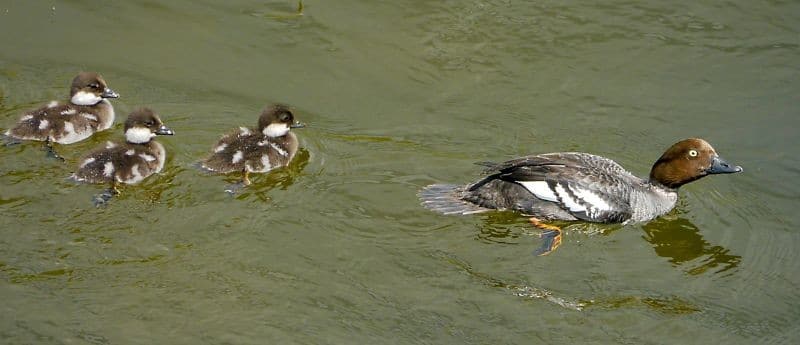
Above: An anxious female Common Goldeneye with three of her young brood at the William River bridge on Highway 6, 20 June 2017; by Peter Taylor.
Conservation Status:
Common Goldeneye numbers appear to be stable, though there is limited information on Asian populations, and there is no immediate conservation concern.
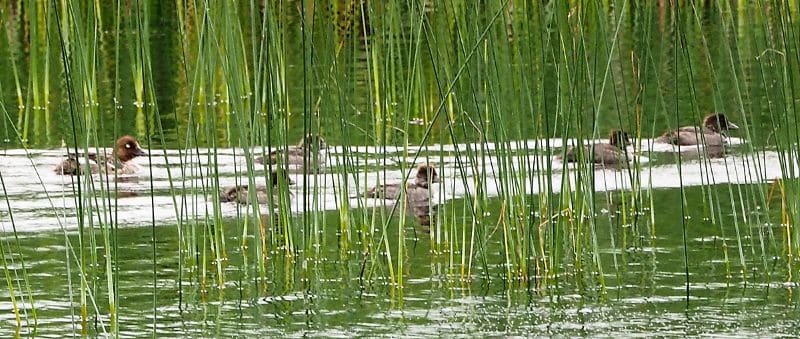
Above: A female Common Goldeneye (extreme left) ushers her well-grown brood to safety at North Shoal Lake, 19 July 2023; by Peter Taylor.
Did you know:
Barrow’s Goldeneye is a close relative of the Common Goldeneye with populations in both eastern and western North America as well as Iceland, but it is extremely rare in Manitoba.
Written by Peter Taylor