

Female and male Mallard, Assiniboine Park, photo by Rudolf Koes
What does it look like?
This largest of our dabbling ducks is familiar to all. The breeding-plumaged male has an iridescent green head, white neckband, dark rufous breast and a black base with a little curl to its white tail. The remainder of the plumage is grey, with a blue speculum bordered by white in both sexes. Females, like all other dabbling ducks, are a mottled brown. This provides camouflage on the nest. From late summer to early winter Mallards become more difficult to identify, as they have assumed a non-descript eclipse plumage.
Does it migrate?
The vast majority of our breeders vacates the province in fall, sometimes lingering into early winter, with small numbers remaining at a few traditional spots throughout that season. Most birds travel only as far south as needed, to areas with open water and available food. In spring it is one of our earliest migrants, arriving any time in March or April.
Where does it live?
Mallards are widespread in Manitoba, ranging from the south to the shores of Hudson Bay. They breed commonly in city parks and at retention ponds, in marshes and near creeks and rivers. Nests may be located a considerable distance from water, which forces the female – only she looks after the brood – to escort the young to water after hatching.
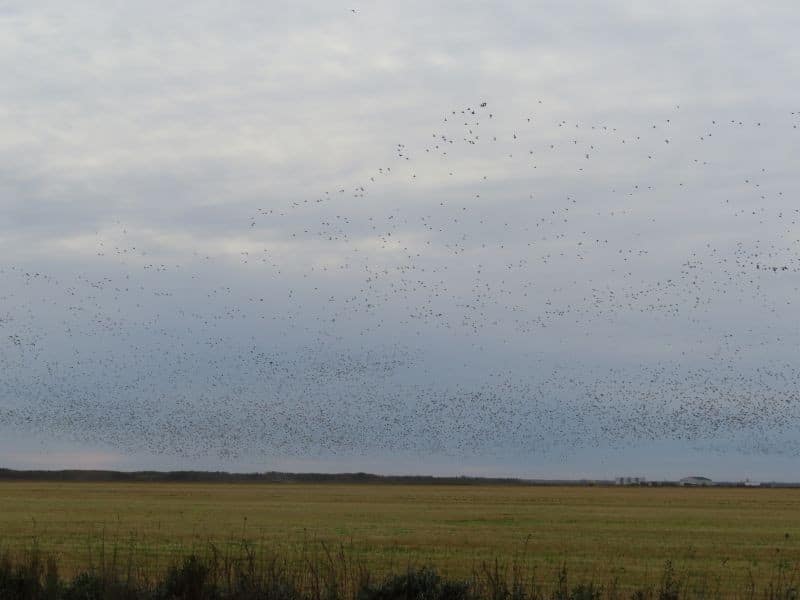
Mallards flying at Oak Hammock Marsh, photo by Rudolf Koes
Where can I see it?
Any pond in a city park should harbour Mallards as long as there is open water. Marshes such as at Delta, Oak Hammock and Whitewater Lake are great places to see them in numbers. During fall, after most grain has been harvested, thousands of birds may descend on the fields for a meal.
Conservation:
One of the few success stories regarding bird populations in recent decades has been the increase in most duck species, Mallard being one of them. Even though it is widely hunted, it is prospering.
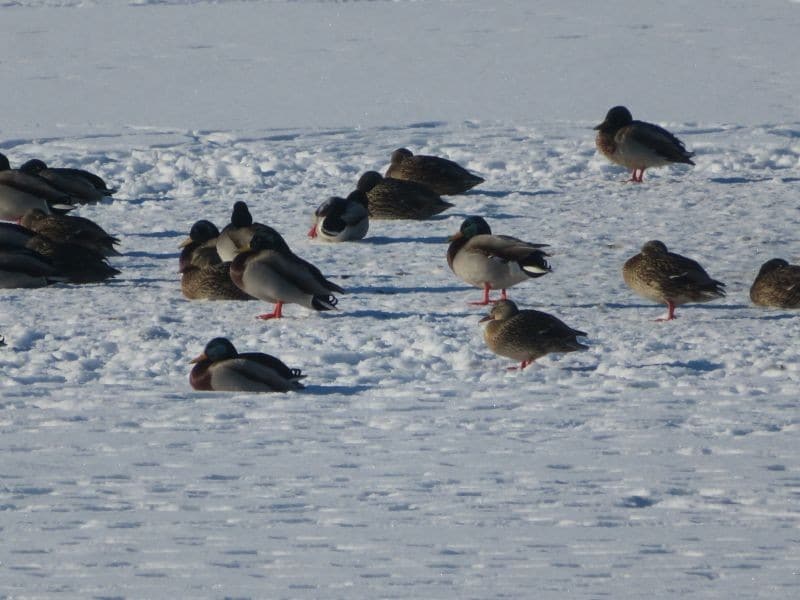
Mallards gathered on the Red River at the South Perimeter, photo by Rudolf Koes
Did you know?
A reliable place to see Mallards in winter has been open water on the Red River near the intersection of St Mary’s and the south Perimeter (opposite King’s Park). Up to a few hundred birds may be here in mid-winter, with the odd American Black Duck amongst them. Water is kept open by effluent from the nearby water treatment plant. Smaller numbers are often found at the mouth of Sturgeon Creek in Winnipeg, below the dam at Lockport and in the artesian drain along Rd. 84N, north of Oak Hammock Marsh.
Written by Rudolf Koes